What vanadinite is
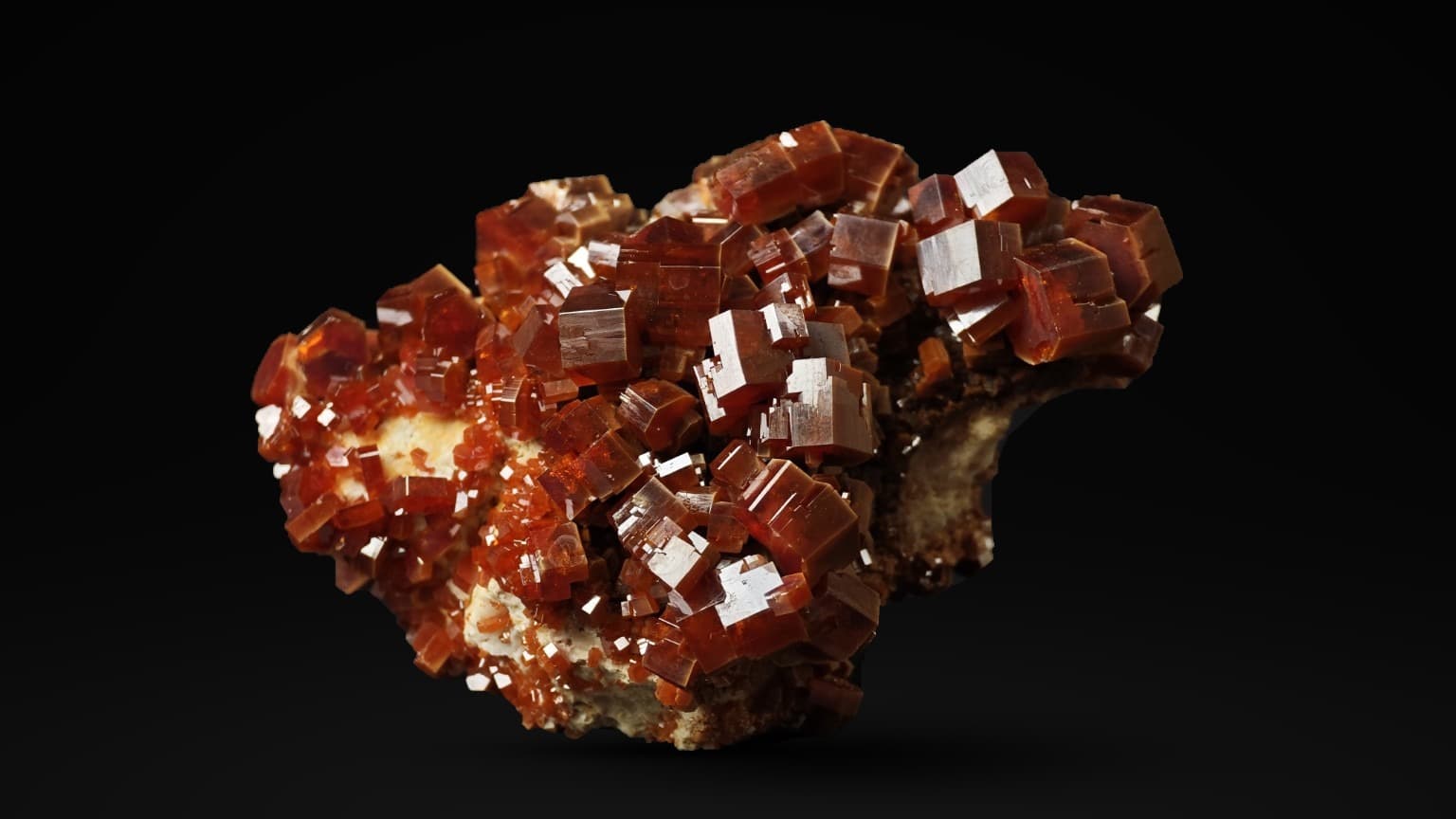
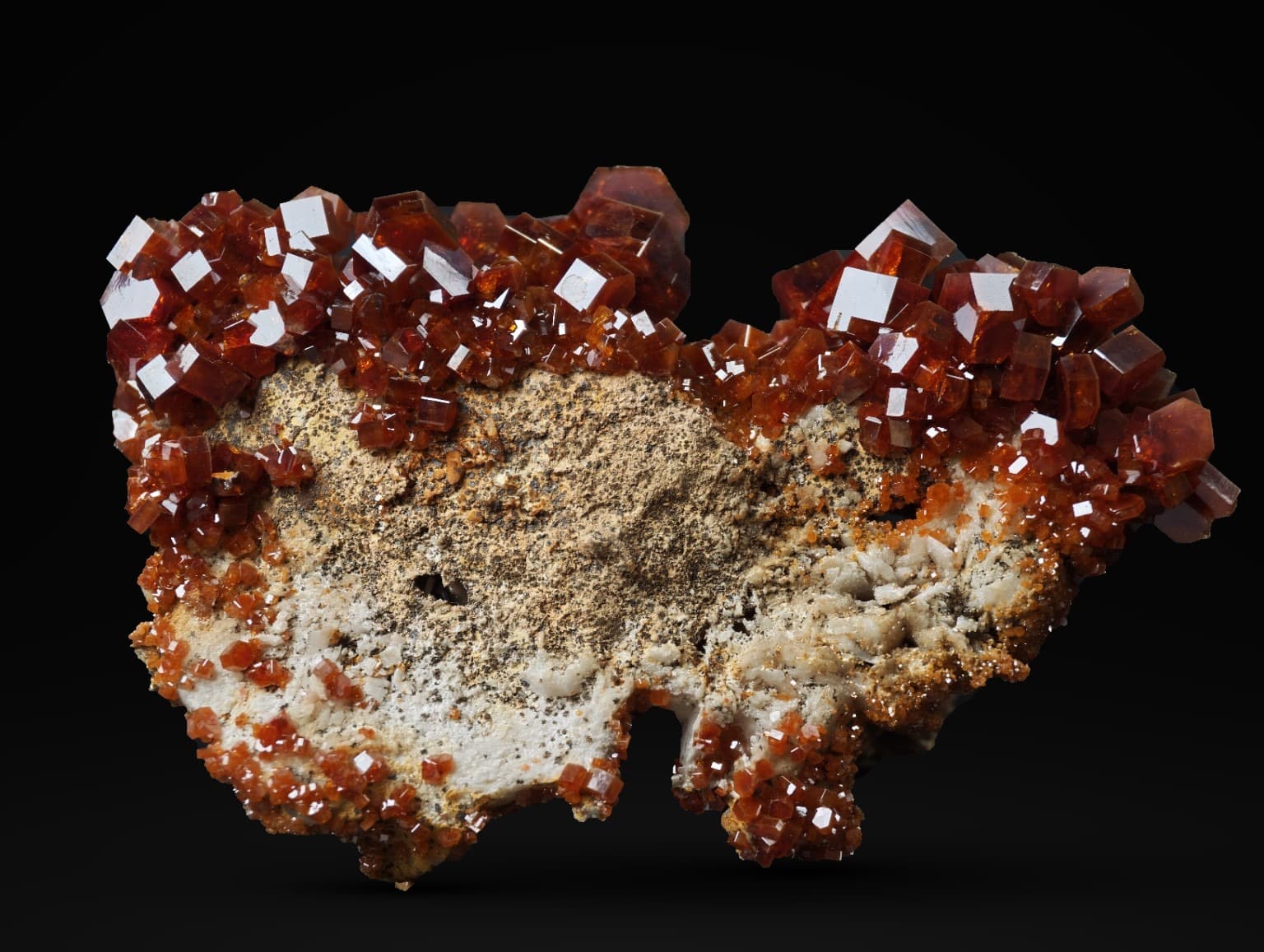
Vanadinite is a secondary mineral. It forms when lead ore, usually galena, breaks down near the surface and reacts with vanadium carried by groundwater. It belongs to the apatite group and grows as short hexagonal prisms, from needle-thin to barrel-shaped, in red, orange-red, brown and occasionally yellow.
It is unusually heavy. With a specific gravity near 7, a vanadinite crystal weighs about two and a half times as much as quartz of the same size. It is also soft and brittle: at 3 to 4 on the Mohs scale, roughly the hardness of a copper coin, its edges chip easily.
The mineral has an odd place in chemistry. Andrés Manuel del Río found it in Mexico in 1801, called it brown lead, and correctly claimed it held a new element. He was talked out of it. The element was rediscovered in 1830 and named vanadium, and del Río's brown lead was renamed vanadinite after it was found again at Zimapán in 1838. Vanadinite is still one of the industrial ores of vanadium.
Mibladen, the district behind most collection vanadinite
Vanadinite is known from more than 400 mines, but Wikipedia's summary is blunt: the Mibladen vanadinites are likely the most popular specimens for mineral collectors. The district lies about 25 km north of Midelt, in Morocco's Drâa-Tafilalet region, in Lower Jurassic limestones and dolomites that also carry galena, barite, cerussite, wulfenite and anglesite.
The deposits were found in 1907 and mined industrially from 1912, from 1926 by the Société des mines d'Ahouli, part of the Peñarroya group. In the 1950s and 1960s about 1,500 miners worked there. The mine closed in 1975.
Since then the old galleries have been worked by hand. Families dig for lead ore and collection specimens, women included since the early 2000s, and ore sells for 1.5 to 2.5 dirhams a kilo. Accidents and silicosis are part of that history. Every specimen from Mibladen on the market today, including ours, comes out of this artisanal work, which is one reason we buy directly from the people who dig.
Two other Moroccan localities matter. Touissit, in the northeast, produced an arsenic-rich variety called endlichite, paler and more yellow. Taouz, near Erfoud, produces vanadinite on dark goethite, a strong contrast to the classic Mibladen red on white barite.
How to judge a vanadinite specimen
Collectors do not pay by weight. Two pieces of the same size can differ tenfold in price. These are the points that decide it, roughly in order of weight:
- Size of the main crystals, not of the rock. A few sharp 1 cm crystals beat a fist-sized matrix dusted with 1 mm ones.
- Colour: saturated red to orange-red, even across the crystals. Judge it in daylight; warm indoor light flatters vanadinite.
- Lustre on the crystal faces. Frosted or etched faces lower the value.
- Sharp hexagonal outlines with flat faces and clean edges.
- Condition of the front: chipped tips or broken crystals on the display side cost far more than damage on the back.
- Contrast with the matrix. Red crystals on white or cream barite is the classic Mibladen look.
- Presentation: a clear front, the best crystals in view, and a piece that sits steadily.
What vanadinite costs: price data from October 2026
We read the asking prices of two established dealers on 28 October 2026. These are asking prices, not sales, but they show the spread well.
| Source | Listings | Price range | Notes |
|---|---|---|---|
| iRocks, Moroccan pieces | 19 | $300 to $12,500 | Median $1,450. Most from the ACF mine, Mibladen. |
| iRocks, examples | $500 / $6,000 / $12,500 | Thumbnail 2.2 cm / small cabinet 7.2 cm / cabinet 13.8 cm | |
| FossilEra, all vanadinite | 12 | $19 to $595 | Small Arizona pieces from $19 |
| FossilEra, Moroccan | 4 | $275 to $595 | Clusters 3 to 12 inches |
Glued, oiled or repaired: what to check before you buy
We know of no dyed or synthetic vanadinite on the collector market. The tricks are mechanical: loose crystals glued back onto matrix, crystals glued onto a barite piece they never grew on, a cracked matrix rebuilt, or a coat of oil or varnish to fake lustre.
- Look at the base of each crystal with a loupe. A glue line or a shiny rim where crystal meets rock is the usual sign.
- If the matrix shines as much as the crystals, the piece is probably coated. Natural lustre is on the crystal faces only.
- Ask for photos of the back and the sides, and a short video turning the piece. Repairs hide on the side nobody photographs.
- A UV torch can make some glues and resins glow. It is a hint, not proof.
- Prefer a precise locality, such as a named mine at Mibladen, over a vague 'Morocco'.
Is vanadinite toxic? Handling and care
Vanadinite is about 73% lead by weight, and it also contains vanadium. Handling and displaying it is safe. The risk comes from swallowing it or breathing its dust.
Wash your hands after handling. Never lick it, put it in water you will drink, or use it in an elixir. Do not cut, grind or sand it. Keep it away from small children and pets.
To clean it, use a soft brush or a blower. Avoid ultrasonic cleaners and acids; a quick rinse in plain water does no harm, but soaking can loosen the matrix and any old repair. As a precaution, display it out of direct sunlight.
About spiritual and healing claims
Searches for vanadinite's spiritual meaning are common. We sell vanadinite as a natural object, for its geology and its beauty, and make no healing or metaphysical claims. Because it contains lead, it should never be used in contact with food, drink or skin for long periods.
Questions collectors ask
Why is vanadinite so expensive?
Ordinary vanadinite is not: small pieces sell from about $20. Fine specimens are expensive because large, sharp, undamaged crystals are scarce. The Mibladen mine closed in 1975, specimens now come from hand digging, and crystals this soft are easily damaged on the way out of the ground. Top Moroccan pieces reach $6,000 to $12,500 at specialist dealers.
Is vanadinite rare?
The mineral is uncommon but known from more than 400 mines. Collection-quality crystals are rare, and Mibladen in Morocco is the main source.
Is vanadinite toxic?
It contains about 73% lead and some vanadium. It is safe to handle and display. Wash your hands afterwards, never ingest it or use it in drinks or elixirs, and do not cut or grind it.
How can I tell if vanadinite is real?
Vanadinite is not faked from other materials. Check instead for crystals glued onto matrix, rebuilt matrix and oil or varnish. Look at crystal bases with a loupe, compare the shine of crystals and matrix, and ask for photos of the back.
Where is vanadinite found?
Mibladen in Morocco is the best-known locality. Others include Touissit and Taouz in Morocco, Arizona and New Mexico in the United States, Mexico, Argentina and Namibia.